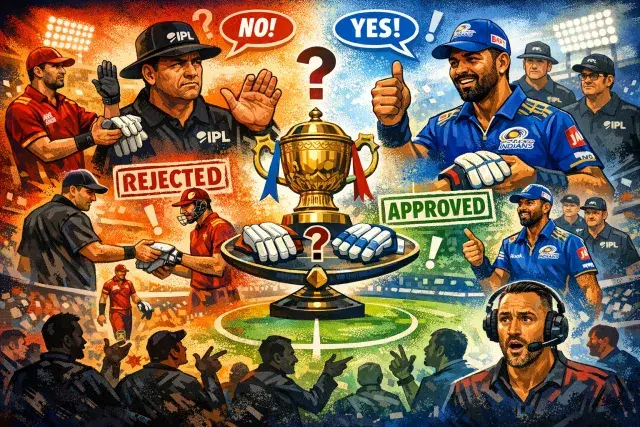

Two separate incidents involving glove changes during the 2026 Indian Premier League have exposed what critics are calling a troubling inconsistency in on-field decision-making. Within the space of a single day, one batter was refused permission to change his gloves mid-over while another — Hardik Pandya — was permitted to do so twice within the same over, in plain view of the officiating crew. The contrast has ignited a sharp and widespread debate about the application of playing conditions and the standard of umpiring consistency across the competition.
What Happened and Why the Sequence Matters
The first incident occurred during a contest between Delhi Capitals and Chennai Super Kings, when Tristan Stubbs sought fresh gloves during his time at the crease. The umpires refused to allow a support staff member onto the field of play, resulting in a confrontation. Stubbs was subsequently dismissed, and he left the field visibly frustrated. The denial was applied under playing conditions that govern when and how equipment can be replaced during an active over.
Less than twenty-four hours later, during a game between Mumbai Indians and Royal Challengers Bengaluru, Pandya changed his gloves not once but twice during the 12th over. On both occasions, this occurred with the umpires present and observing. Broadcast cameras captured the exchanges clearly, and commentary from former international cricketers — including Faf du Plessis — reflected open surprise at the permissiveness being extended. The juxtaposition of the two rulings gave the controversy its sharpest edge: identical circumstances, sharply different outcomes.
The Regulatory Framework and Where It Breaks Down
The Laws of Cricket, as maintained by the Marylebone Cricket Club, and the supplementary playing conditions issued by the Board of Control for Cricket in India for its franchise competition, place the authority for on-field decisions squarely with the umpires. Equipment changes — including gloves — are generally permitted between overs or in cases of genuine medical necessity during an over, but the precise interpretation is left to the officiating crew's judgment in the moment.
This discretionary latitude is, in principle, designed to handle edge cases fairly. In practice, it creates room for inconsistency when different officiating crews apply the same rule differently across different fixtures. What the current situation illustrates is a failure not necessarily of the written rule but of its uniform enforcement. When a rule produces visibly contradictory outcomes in back-to-back fixtures, trust in the officiating process erodes — regardless of whether each individual decision was technically defensible in isolation.
The Wider Implications for On-Field Governance
The Nitish Rana incident adds another dimension. Rana, the Delhi Capitals representative who attempted to bring gloves onto the field, was subsequently fined for using obscene language during his exchange with the umpires. Whatever the merits of that fine, it underscores that the original incident carried real consequences for at least one party involved — while the parallel situation the following day appeared to carry none.
Competitions of this scale depend heavily on the perception of procedural fairness. When officiating appears to operate differently depending on who is at the crease or which fixture is being contested, the legitimacy of rulings across the board comes into question. The IPL Code of Conduct exists precisely to ensure accountability on and off the field, but that mechanism functions only when it is applied consistently and transparently. Whether the governing body chooses to review the umpiring decisions from both incidents — or issue any clarification on the applicable standard — will say a great deal about how seriously the inconsistency is being taken internally.
What Needs to Happen Next
The immediate demand from observers and commentators is straightforward: a clear, publicly communicated standard on when equipment changes are and are not permitted during an active over. That standard should be applied uniformly across all fixtures and officiating crews, with no visible variation based on circumstances that have nothing to do with the rule itself.
Beyond the immediate controversy, this episode points to a structural need within high-profile officiating: tighter pre-competition briefings for umpiring panels, clearer written protocols for equipment-change situations, and a review mechanism that can identify and correct inconsistencies as a competition progresses rather than after public pressure forces the issue. The details here are small — gloves, a few minutes, two separate fixtures — but the principle at stake is the integrity of the officiating process itself, and that is never a small matter.