
Most people think of email accounts as something you create once and keep for years. But for developers, marketers, testers, and automation professionals, the need to manage dozens or even hundreds of accounts simultaneously is a practical reality - not an edge case. Microsoft's Hotmail platform, now operating under the Outlook infrastructure, remains one of the most widely accepted email services across third-party platforms, verification systems, and business tools. That makes bulk Hotmail accounts a genuinely useful asset for a wide range of professional workflows.
The challenge is that acquiring and registering multiple accounts comes with real friction. Microsoft's Hotmail registration process includes phone verification steps, IP-based rate limiting, and behavioral detection that can block bulk sign-up attempts before they succeed. For anyone who needs to purchase email accounts in volume or register them efficiently at scale, understanding the available methods - and their trade-offs - is essential. Those who prefer a ready-made solution can buy hotmail accounts at https://accsmarket.com/en/catalog/drugie-pochty/hotmail, where pre-registered accounts are available in bulk quantities with verified access credentials.
This guide walks through the full process: why bulk Hotmail accounts are in demand, how disposable email services fit into the registration workflow, how to evaluate account quality, and what risks and responsibilities come with managing accounts at scale. Whether you are building a testing environment or sourcing accounts for outreach infrastructure, the information here gives you a structured foundation to work from.
Why Bulk Hotmail Accounts Are in Demand
Hotmail - now fully integrated into Microsoft's Outlook ecosystem - carries a level of domain trust that many newer email services simply do not have. Platforms that validate email addresses during sign-up tend to accept @hotmail.com and @outlook.com addresses without friction, which makes them particularly useful for account creation at scale.
The demand for bulk email accounts tied to the Hotmail domain comes from several professional contexts. Software testers need multiple accounts to simulate real user behavior across different permission levels. Email marketing professionals use separate accounts to manage sending domains, test deliverability, and segment outreach campaigns. Automation developers building bots or scrapers often require accounts to interact with platforms that require email-based authentication. Affiliate marketers may need accounts to manage separate tracking environments or test sign-up funnels.
There is also a simpler use case: businesses that run multiple client projects may need distinct Hotmail accounts per client to keep communications, integrations, and API credentials cleanly separated. Managing this at scale without a structured approach leads to disorganization and security vulnerabilities.
- Software QA and automated testing across different user roles
- Email outreach campaigns requiring isolated sending identities
- Affiliate and performance marketing account separation
- Multi-client management for agencies and developers
- Bot and automation script development requiring valid email authentication
- Platform testing where email-based sign-up is mandatory
Understanding why the demand exists helps clarify what quality standards matter when evaluating accounts - a point that becomes important when choosing between self-registration and purchasing ready-made bulk email accounts.
Understanding Hotmail Registration and Its Limitations at Scale
Creating a single Hotmail account is straightforward. Creating fifty in a short timeframe is a different matter entirely. Microsoft has built progressive friction into its Hotmail registration system specifically to limit automated and bulk account creation. Knowing where that friction originates helps you work around it effectively - or decide that purchasing pre-registered accounts is the more practical path.
How Microsoft Detects Bulk Sign-Up Attempts
Microsoft's account creation system monitors several signals simultaneously. IP address reputation is one of the most immediate filters: multiple Hotmail sign-up requests from the same IP address within a short window trigger rate limits or outright blocks. Beyond IP, Microsoft tracks browser fingerprints, device identifiers, and behavioral patterns during the registration flow - such as how quickly forms are completed and how the mouse moves.
CAPTCHA challenges are inserted dynamically when the system detects unusual patterns. Phone number verification is required in most cases and is tied to specific regional number pools, which means virtual or recycled phone numbers are frequently rejected. These measures combined make fully automated Hotmail registration without human-like behavior extremely difficult.
Common Barriers During Hotmail Registration
Even manual bulk registration runs into predictable obstacles. Microsoft limits the number of accounts that can be created from a single phone number, so the same mobile number cannot be reused indefinitely. Recovery email requirements also appear during registration and may require a secondary email address that Microsoft can verify independently.
Geographic inconsistencies - for example, using a Russian proxy IP while providing a US-based phone number - can trigger additional verification steps or outright rejection. Account creation from cloud server IP ranges, including those from common VPS providers, is frequently flagged because Microsoft recognizes data center IP blocks as non-residential.
- IP rate limiting from repeated registration attempts on the same address
- Phone number reuse restrictions limiting account volume per number
- CAPTCHA challenges triggered by automation-like behavior
- Data center IP rejection due to non-residential traffic patterns
- Mismatch detection between geographic signals and provided contact data
- Recovery email verification adding an additional dependency
When Self-Registration Makes Sense
Self-registration remains viable when account volume is low, when time is not a constraint, and when the accounts need specific profile configurations that a pre-purchased batch cannot provide. For teams that require accounts with specific regional settings, particular recovery options, or custom display names tied to a project, building accounts manually or semi-manually with controlled conditions gives the most flexibility.
For anything above a few dozen accounts, the overhead of managing phone numbers, IP rotation, and CAPTCHA handling tends to outweigh the control benefits. At that scale, purchasing bulk email accounts or using disposable email services as intermediaries becomes more efficient.
The Role of Disposable Email Services in Bulk Account Setup
Disposable email services generate temporary, functional email addresses that expire after a set period or after a single use. In the context of bulk Hotmail account setup, they serve a specific and practical function: they provide the secondary or recovery email addresses that Microsoft requests during Hotmail registration without requiring you to create and manage additional permanent accounts for that purpose.
What Disposable Email Services Actually Provide
A disposable email service gives you a temporary inbox that can receive messages, including verification emails, confirmation links, and one-time codes. The address typically follows a random or customizable format on a third-party domain. Messages arrive in a publicly accessible or privately generated inbox and can be read for a limited time before the address expires.
For bulk Hotmail registration, these addresses are useful at the recovery email stage. Instead of building a chain of permanent secondary accounts, you can use disposable addresses to satisfy Microsoft's recovery email field during sign-up, receive any confirmation message required, and move on. Once the Hotmail account is active and you have logged in to confirm it, the disposable address has served its purpose.
Limitations of Disposable Email Services in This Context
Disposable email services have meaningful limitations that affect their reliability in a bulk registration workflow. Microsoft maintains a blocklist of known disposable email domains. Many of the most widely used disposable services are already flagged, meaning the system will reject the address during registration or flag the account for review shortly after creation.
Lesser-known or rotating disposable domains are more likely to pass initial validation, but they may not remain functional long enough to receive a confirmation message if Microsoft sends one with a delay. Additionally, some disposable inboxes are publicly accessible, which means any confirmation link sent to that address could theoretically be accessed by someone else if they know or guess the address.
- Many major disposable domains are already blocked by Microsoft
- Inbox expiration may prevent receiving delayed verification messages
- Public inboxes carry a risk of unauthorized access to confirmation links
- Disposable addresses cannot serve as long-term recovery contacts for account security
Best Practices When Using Disposable Email Services
To use disposable email services effectively during Hotmail registration, prioritize services that generate private, non-public inboxes with unpredictable address formats. Avoid domains that appear on widely distributed disposable email blocklists. Test a given disposable domain against Microsoft's registration form before using it at scale to confirm it is not already blocked.
Keep a log of which disposable addresses were used for which Hotmail accounts during the registration process. Even though these addresses expire, having a record helps with troubleshooting if an account requires re-verification shortly after creation. Once accounts are active, update the recovery email to a more permanent and controlled address to reduce the risk of losing account access.
How to Purchase Email Accounts in Bulk: What to Look For
Buying pre-registered bulk Hotmail accounts removes the friction of the registration process entirely, but it introduces a different set of considerations. Not all account batches are equal in quality, and buying from unreliable sources can result in accounts that are already flagged, aged poorly, or linked to suspicious activity histories.
Key Quality Indicators for Purchased Accounts
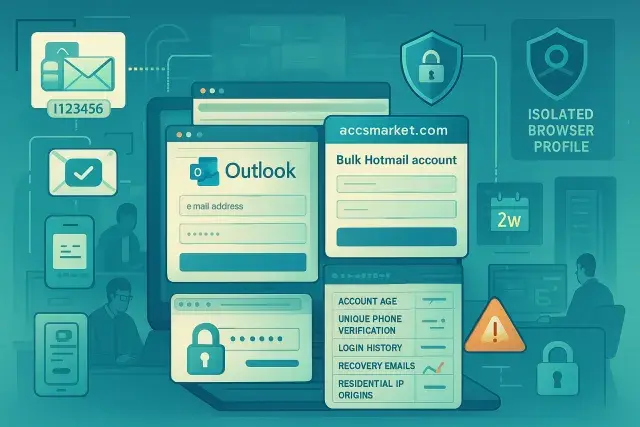
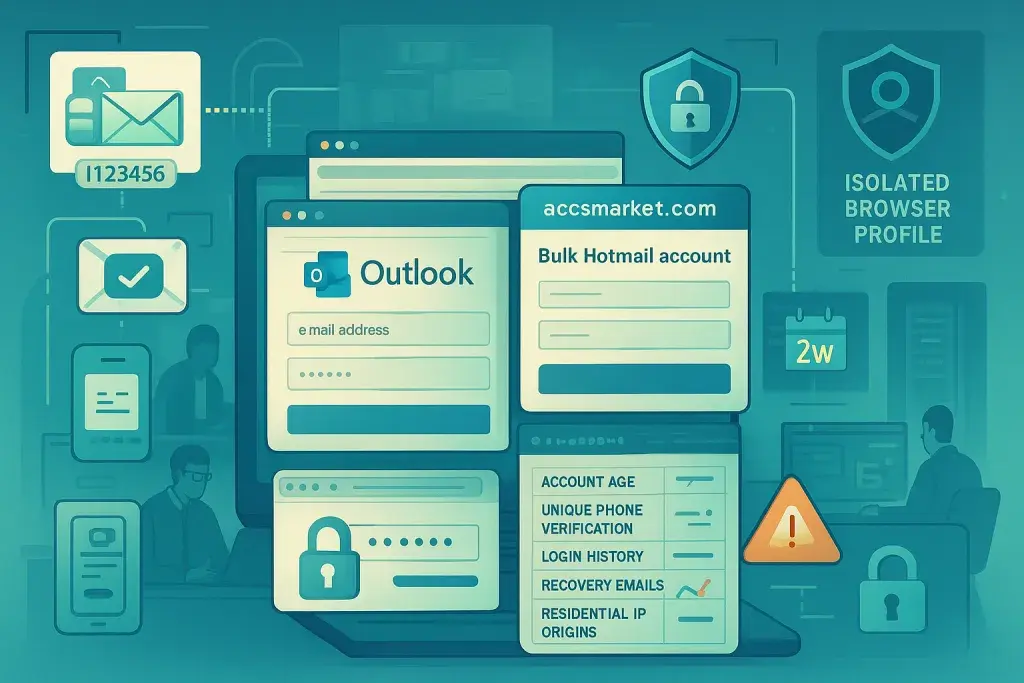
Account age is one of the most important quality factors. Freshly created accounts - those registered within the past few days - are more likely to trigger Microsoft's new-account limitations, such as sending restrictions or additional verification prompts when logging in from a new device. Aged accounts that have been active for several weeks or months tend to behave more like established users and face fewer automatic restrictions.
Verified phone numbers add another layer of credibility. Accounts that were registered with real, unique phone numbers are less likely to be suspended in batch events triggered by Microsoft when it identifies accounts that share verification credentials. Each account should have been created with a distinct phone number - not one recycled across dozens of registrations.
| Quality Factor | What to Look For | Why It Matters |
|---|---|---|
| Account Age | At least several weeks since creation | Reduces new-account sending limits and verification prompts |
| Phone Verification | Each account verified with a unique number | Prevents batch suspensions from shared credentials |
| Login History | At least one or two prior logins recorded | Establishes basic activity pattern, reduces anomaly flags |
| Recovery Email | Functional recovery email set at creation | Ensures access recovery options are available |
| IP Origin at Creation | Residential IP used during registration | Lowers detection risk associated with data center addresses |
Evaluating Account Sellers and Marketplaces
When choosing where to purchase email accounts, look for sellers that provide transparent documentation on how accounts were created, what verification methods were used, and what activity has occurred on the accounts since creation. Reputable marketplaces offer replacement guarantees for accounts that fail to log in within a defined window after purchase - typically 24 to 72 hours.
Avoid bulk account batches sold at unusually low prices with no quality documentation. These are frequently sourced from automated registration scripts that produce accounts Microsoft has already or will soon flag. The short-term cost saving is offset by high account failure rates and wasted time managing replacements.
Check whether the seller provides accounts with accessible credentials - username, password, and recovery details - in a clean, organized format. Disorganized or incomplete credential sheets are a sign of low-quality sourcing processes and make account management unnecessarily difficult at scale.
Setting Up and Managing Bulk Hotmail Accounts Securely
Acquiring bulk Hotmail accounts is only the first step. Managing them securely and keeping them functional over time requires deliberate setup practices. Accounts that are logged into carelessly, used from flagged IPs, or left idle for extended periods are at higher risk of triggering Microsoft's security systems.
IP Management and Browser Profiles
Each Hotmail account should ideally be accessed from a consistent, unique IP address. Using the same IP for dozens of accounts simultaneously is one of the fastest ways to trigger mass suspension. Residential proxies - addresses assigned to real household connections rather than data centers - are significantly more reliable than datacenter proxies for this purpose.
Browser profile isolation is equally important. Anti-detect browsers allow you to create separate browser environments with distinct fingerprints for each account. This prevents Microsoft from linking multiple accounts through shared canvas fingerprints, timezone data, screen resolution patterns, or plugin configurations. Each account should exist in its own isolated profile that is used consistently.
Account Warming and Activity Patterns
A newly acquired or registered account that immediately sends large volumes of email or accesses external platforms at high frequency looks suspicious. Account warming refers to the practice of establishing a natural usage pattern before deploying the account for its intended purpose.
Warming involves logging into the account periodically, reading the inbox, adjusting basic settings, and sending a small number of messages to legitimate addresses over the first week or two. This creates an activity baseline that makes subsequent higher-volume use less likely to trigger automated review. The warming period does not need to be extensive - even modest, consistent activity is more valuable than an account that was created and then immediately hammered with bulk actions.
Password and Credential Security
Bulk accounts present credential management challenges that individual accounts do not. Storing dozens of username-password combinations in plain text files or unencrypted spreadsheets creates a significant security exposure. A compromise of that file means losing all accounts simultaneously.
Use a password manager or encrypted credential vault to store account details. Assign strong, unique passwords to each account rather than using patterns like incremental variations on a base password. If the accounts were purchased with default or vendor-assigned passwords, change them immediately upon first login before deploying the accounts for any purpose.
- Store credentials in an encrypted password manager, not plain text files
- Change vendor-assigned passwords on first login
- Use unique passwords for each account - avoid sequential or patterned variations
- Record recovery email and phone details alongside login credentials
- Back up credential files in a secure, access-controlled location
Risks, Compliance, and Responsible Use
Operating bulk Hotmail accounts at scale carries real risks - technical, operational, and policy-related. Microsoft's Terms of Service prohibit the creation of accounts through automated means and restrict certain types of bulk activity. Understanding where the boundaries are helps you operate within them where possible and make informed decisions where trade-offs exist.
Microsoft's Terms of Service and Account Policies
Microsoft explicitly prohibits automated account creation, the use of accounts for sending unsolicited bulk email, and activities that interfere with the platform's normal operation. Accounts found to be in violation of these terms can be suspended without notice, and in cases of large-scale abuse, associated IP addresses and device identifiers may be flagged across Microsoft's broader platform ecosystem.
This does not mean all bulk account use violates the terms - testing environments, development accounts for application integration, and legitimate multi-account management for distinct business purposes may fall within acceptable use depending on implementation. The distinction lies primarily in intent and activity: accounts used for spam, phishing, or fraudulent purposes are clearly outside policy boundaries, while accounts used for development testing or isolated project management occupy a different position.
Technical Risks of Managing Accounts at Scale
Beyond policy risk, there are practical technical risks associated with bulk account management. Shared proxies used across multiple accounts can create a single point of failure - if that proxy is flagged, all accounts using it may be reviewed simultaneously. Account recovery becomes complicated when the original registration phone numbers or disposable email addresses are no longer accessible.
Microsoft periodically runs automated reviews that can flag dormant or unusual accounts in batch. Accounts that have had no activity for extended periods, or that show inconsistent geographic access patterns, are more likely to be caught in these sweeps. Maintaining at least minimal periodic activity across the account pool reduces this risk.
- Shared proxy failure can trigger simultaneous review of multiple accounts
- Inaccessible recovery contacts make account recovery impossible after flagging
- Dormant accounts are more vulnerable to batch review and suspension
- Geographic inconsistency in login history increases anomaly detection risk
- Bulk purchasing from low-quality sources may deliver pre-flagged accounts
Ethical Considerations
The technical capability to acquire and operate bulk Hotmail accounts does not automatically make every use case appropriate. Accounts used for coordinated inauthentic behavior, spam distribution, platform manipulation, or any form of fraud cause real harm to other users and degrade the reliability of email as a communication tool.
Responsible bulk account use focuses on legitimate operational needs: testing, development, project separation, and controlled outreach within platform rules. Being clear about the purpose before acquiring accounts in volume helps avoid situations where the infrastructure you build creates more legal and reputational exposure than the original problem warranted.
Questions and Answers
Can I use the same phone number to register multiple Hotmail accounts?
Microsoft limits the number of accounts that can be associated with a single phone number during Hotmail registration. Attempting to register more than a small number of accounts with the same number will typically result in the system rejecting the number or requiring an alternative verification method. For bulk registration, each account should ideally use a unique phone number.
How long should I wait before using a purchased Hotmail account for outreach?
A warming period of one to two weeks is generally advisable before using a purchased account for any high-volume activity. During this time, log into the account periodically, interact with the inbox naturally, and send a small number of messages to verify the account is functioning without restrictions. This reduces the likelihood of triggering sending limits tied to new or unfamiliar account behavior.
Are all disposable email services blocked by Microsoft during Hotmail sign-up?
Not all disposable email domains are blocked, but the most widely used ones are. Microsoft maintains a list of known temporary email providers and rejects addresses from those domains during registration. Less common or newly created disposable domains may still be accepted, but their reliability varies. Testing a disposable domain against the registration form before using it at scale is the practical way to verify its current status.
What happens to my bulk Hotmail accounts if I stop using them?
Microsoft can mark inactive accounts for deletion after an extended period of inactivity - typically around two years for consumer accounts, though this policy can change. Beyond deletion risk, inactive accounts are more likely to be flagged in automated security reviews. Maintaining periodic activity across your account pool keeps them in good standing and preserves access when you need them again.
Is there a way to recover a purchased Hotmail account if I lose access?
Recovery depends on what credentials and contact information were set up at the time of registration. If the account has a linked recovery phone number or recovery email that you control, Microsoft's account recovery process can restore access. If those recovery contacts are inaccessible - for example, a disposable email that has expired - recovery becomes significantly harder. Always update recovery contacts to addresses and numbers you control immediately after acquiring an account.
What is the difference between bulk accounts purchased from a marketplace versus self-registered accounts?
Marketplace accounts are pre-registered by the seller, typically in bulk using controlled conditions, and delivered with login credentials ready to use. Self-registered accounts give you full control over the registration process, profile details, and activity history from the start. Marketplace accounts save time and sidestep registration friction, but their quality depends entirely on the seller's sourcing practices. Self-registered accounts require more effort upfront but carry a known and verifiable creation history.
